English vs. Hindi: Which Language Should You Best Language for Agriculture Articles
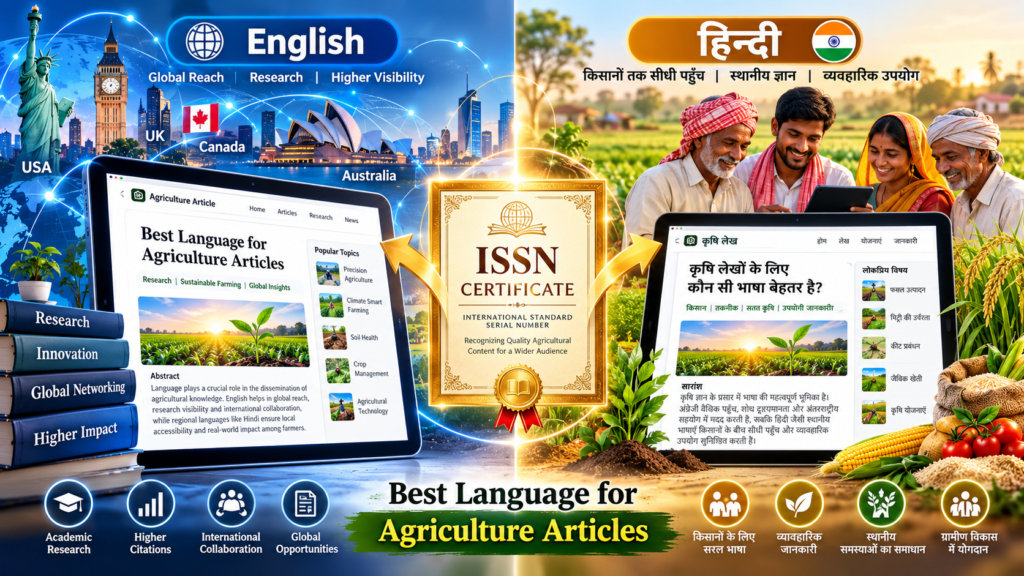
Table of Contents
One of the most common dilemmas agriculture students face before writing their first publication is the language barrier. Many brilliant scholars hesitate to share their knowledge because they feel their English grammar is not “perfect.” On the other hand, some worry that writing in Hindi might not carry enough academic weight for competitive exams.
If you are stuck in the English vs Hindi agriculture article debate, you are losing valuable time. The truth is, the agricultural sector in India uniquely bridges high-level global science with grassroots farming. Because of this, both languages hold immense power, but they serve different purposes.
Let us break down the advantages of each language so you can confidently choose the best language for agriculture articles and get published this week.
The Case for Writing in English
English is the undisputed global language of science. If your primary goal is purely academic advancement, writing in English offers specific advantages.
1. The Standard for Competitive Exams
If you are preparing for the ICAR JRF, SRF, or aiming for a Ph.D. admission, English is the default language for most interview panels. Having a portfolio of English articles demonstrates your professional communication skills to the evaluators.
2. Global Readership and Citations
If you are writing on highly technical, modern topics—such as AI in precision farming, genome editing (CRISPR), or advanced nanotechnology in fertilizers—English is the preferred medium. Researchers across the globe can read, share, and cite your work.
3. Easier Technical Vocabulary
Let’s face it: agricultural science is filled with complex terminology. Sometimes, using terms like “Integrated Pest Management (IPM)” or “Photosynthetically Active Radiation (PAR)” is much easier in English than finding their exact, complex Hindi translations.
The Case for Writing in Hindi
Do not make the mistake of underestimating regional languages. In fact, writing your agriculture article in Hindi might actually be a smarter strategic move for several reasons.
1. Unmatched Local Reach and Farmer Impact
Agriculture is the backbone of India, and the end-user of your research is the Indian farmer. If you write a brilliant article on controlling the Pink Bollworm in cotton in English, a farmer in Maharashtra or Madhya Pradesh might never read it. Writing in Hindi ensures your knowledge actually reaches the fields, serving the true purpose of “Agricultural Extension.”
2. The “Low Competition, High Traffic” SEO Advantage
Here is a secret that most students do not know: Google is aggressively pushing regional language content in India. There are thousands of articles on “Wheat Cultivation” in English, making it hard to rank. But if you write “गेहूं की फसल में खरपतवार नियंत्रण” (Weed control in wheat), your article has a much higher chance of appearing on the first page of Google. This brings massive readership to your publication.
3. Faster and Authentic Expression
If your native thought process is in Hindi, forcing yourself to write in English can make your article sound artificial or copied. Writing in Hindi allows you to express your ideas naturally, fluidly, and much faster.
The Ultimate Solution: Which One Should You Choose?
The answer is simple: Choose the language in which you can explain the concept most clearly without plagiarizing.
If you are writing about a deeply scientific, lab-based topic, choose English. If you are writing a practical, solution-oriented popular article meant to solve a field problem (like disease management or organic farming), Hindi is an incredibly powerful choice.
The most important factor is not the language itself, but the credibility of the platform where you publish it. Whether you write in English or Hindi, your article must be published in a recognised magazine that provides a valid ISSN number. An ISSN publication in Hindi holds the exact same legal and academic validity as one in English
Publish in Your Preferred Language Today!
Stop letting language hold you back from building a stellar academic CV. Whether you are comfortable drafting your manuscript in English or prefer the authentic reach of Hindi, the right platform will welcome your knowledge.
At Agri Publication (ISSN: 3139-6127), we celebrate both global science and local extension. We proudly accept high-quality popular articles and research papers in both English and Hindi. We provide a frictionless, student-friendly platform where your hard work is recognized instantly.
FAQs for Best Language for Agriculture Articles Blog
Yes, absolutely! Academic panels evaluate the quality of your research, your understanding of the topic, and the authenticity of the publication platform. An article published in Hindi in a valid ISSN-registered magazine carries full academic weight.
Yes. It is actually recommended! You do not need to find difficult Hindi translations for common scientific terms. You can write the article in Hindi but use standard English terms like “Nitrogen,” “Fungicide,” or “Spikelet” in brackets to keep it easy to understand.
No. Publishing the exact same content in two different languages on different platforms is considered “Self-Plagiarism” in academic publishing. You must choose one language for your manuscript before submitting it.
Currently, Hindi agriculture articles see much higher organic search traffic and social media shares in India, especially in farmer and extension worker WhatsApp groups. English articles, however, get more citations from other researchers and scholars.
Agri Publication (ISSN: 3139-6127) is one of the best platforms for students and researchers. We accept submissions in both Hindi and English, offering a fast-track peer-review process that gets your article published within 24 hours with an official e-certificate.