
How to Publish Agriculture Article Online: Step-by-Step Guide
Table of Contents
Are you an agriculture student looking to upgrade your academic profile but feeling overwhelmed by the publication process? You are not alone. Many students hesitate to share their knowledge because they simply do not know how to publish agriculture article online.
Whether you are building your resume for the upcoming ICAR JRF Agronomy exam, preparing for an M.Sc. entrance interview, or just want to share your insights on crop protection, having a published article is a game-changer. It separates you from the crowd and proves your authority in the subject.
In this guide, we break down the exact steps to publish agriculture article online fast, ensuring your hard work gets the recognition it deserves without the typical months of waiting.

Step 1: Select a High-Impact Agriculture Topic
Before you can publish agriculture article online, you need a topic that researchers, professors, and farmers actually care about. Avoid highly generic ideas like “Importance of Agriculture.” Instead, focus on specific, trending, and solution-oriented issues.
Selecting a micro-niche not only makes your article more engaging but also increases its chances of fast approval. Consider these high-demand areas:
Agronomy & Crop Protection: Modern weed management techniques or sustainable farming practices.
Plant Pathology: Identification, prevention, and control of major field crop diseases.
Entomology: Integrated pest management (IPM) strategies for severe insect pests.
Nematology: Analyzing and preventing economic crop loss due to nematodes.
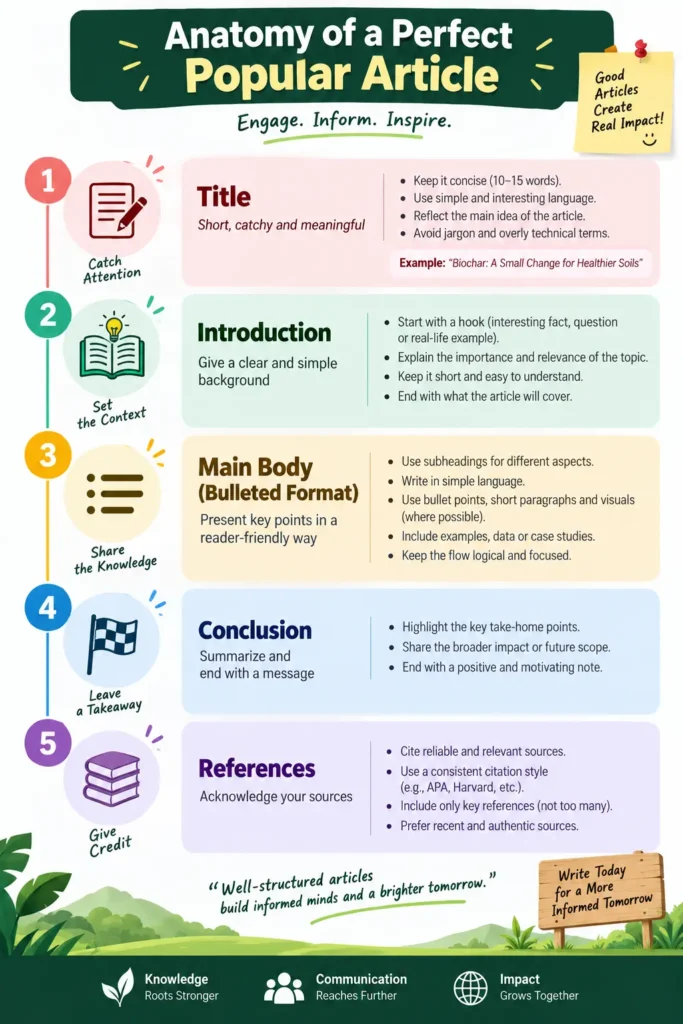
Step 2: Structure Your "Popular Article in Agriculture
A popular article in agriculture is very different from a complex, data-heavy research paper. Its primary goal is to educate the agricultural community in a simple, practical, and highly informative manner.
To ensure your article is accepted instantly, follow this standard structure:
Catchy Title: Keep it under 15 words. Make it clear and action-oriented.
Engaging Introduction: State the problem clearly (e.g., how a specific insect pest damages crops) and outline what the article will cover.
Main Body: Break down the text using H2 and H3 headings. Use short paragraphs and bullet points. Share practical solutions rather than just theory.
Conclusion: Summarize the key takeaway in 2 to 3 lines.
References: Cite 2 to 4 credible sources to back up your claims.
Step 3: Avoid Common Academic Writing Mistakes
Many students get their articles rejected due to easily avoidable errors. Before you proceed to submission, double-check your manuscript for these three things:
Plagiarism: Originality is the backbone of academic writing. Never copy-paste content from the internet. Always write in your own words and use free online tools to check for plagiarism.
Poor Formatting: Ignoring the publisher’s font and spacing guidelines shows a lack of professionalism.
No Clear Conclusion: Articles that end abruptly leave a bad impression. Always conclude with a summary or a future recommendation.
Step 4: Find the Best Platform to Publish Agriculture Article Online
Not all magazines are created equal. When choosing a platform, you must look for credibility, affordability, and speed. If you want your CV to stand out, you need an agriculture magazine with ISSN.
Look for these three non-negotiable features:
Valid ISSN Number: This makes your publication globally recognized, authentic, and academically valid for job interviews.
Transparent Peer-Review Process: Ensures the quality of your content is verified by experts.
Speed: As a student preparing for exams, you cannot wait six months for a response. Look for fast agriculture article publication platforms that review and publish within days.
Step 5: Format, Proofread, and Submit
Now that your content is ready, it is time for the final execution.
Check the Guidelines: Read the target magazine’s author guidelines carefully. Ensure your word count and image formats match their criteria.
Proofread: Read your article aloud to catch grammatical errors.
The Submission Process: Fill out the online submission form, ensure your author and co-author names are spelled correctly, upload your payment receipt (if required), and attach your manuscript.

Where to Publish Agriculture Article Online with ISSN?
If you are wondering where to start, Agri Publication (ISSN: 3139-6127) is built specifically for students, scholars, and professionals. We remove the complex, outdated hurdles of traditional publishing.
Here is why Agri Publication is the best platform to publish agriculture article online:
24-Hour Fast-Track Publication: No more waiting for months. Get your peer-reviewed article published incredibly fast.
Valid E-Certificate: Receive an official author certificate instantly to boost your ICAR JRF exam preparation profile and interview portfolio.
Affordable Processing: Student-friendly fees with zero hidden charges and massive discounts for annual members.
Ready to Share Your Knowledge?
Writing your first article might seem daunting, but once you take that first step, it becomes an incredibly rewarding part of your academic journey. Stop leaving your valuable assignment notes sitting in your notebooks. Turn them into a globally recognized publication today!
Click here to start your agriculture research article submission and get your valid ISSN certificate within 24 hours!
Frequently Asked Questions
Yes, absolutely! Undergraduate and postgraduate students can easily publish “Popular Articles” to share their knowledge on topics like agronomy, crop protection, and plant pathology. It is highly recommended to start publishing early to build a strong academic profile for future exams and interviews.
A research paper is highly technical, requires original experimental data, and uses complex statistical analysis. A popular article in agriculture, however, is written in simple language to educate students and farmers on existing concepts, new farming technologies, or disease management without needing raw data.
An ISSN (International Standard Serial Number) provides global recognition and authenticity to the magazine. When you publish your agriculture article online in an ISSN-approved magazine like Agri Publication (ISSN: 3139-6127), it becomes academically valid and carries weight in ICAR JRF, SRF, and Ph.D. admission interviews.
While traditional journals can take 3 to 6 months to review and publish an article, modern platforms like Agri Publication offer a fast-track process. If your article meets the quality guidelines, it can be peer-reviewed and published within 24 hours, complete with a valid e-certificate.
No, it is not mandatory. You can submit and publish your article as a single author. However, adding your professors, batchmates, or juniors as co-authors is a great way to collaborate and share the academic credit.