Research Paper vs Popular Article in Agriculture: The Complete Guide

Table of Contents
As an agriculture student or early-stage researcher, stepping into the world of academic publishing can feel overwhelming. The most common hurdle students face is understanding the exact difference between a research paper and a popular article in agriculture.
Many scholars delay their publication journey because they assume every article requires years of field trials, complex statistical analysis, and raw lab data. But that is not true! By understanding the distinct purposes, formats, and audiences of both, you can strategically build your academic resume for ICAR JRF, SRF, and university interviews.
Let us explore Research Paper vs Popular Article in Agriculture formats in complete detail so you can confidently start writing.
1. What is an Agriculture Research Paper?
A research paper is a formal, highly technical academic document. It is the primary way scientists share newly discovered knowledge with the world. You cannot write a research paper simply by reading other books; you must conduct original field or lab experiments.
Key Features of a Research Paper:
Target Audience: Fellow scientists, Ph.D. scholars, and academic peers.
The Structure (IMRAD): It strictly follows the traditional scientific structure:
Introduction (The problem and objective)
Methods (Experiment design, e.g., Randomized Block Design)
Results (Raw data, ANOVA tables, graphs)
Discussion (What the data means scientifically)
The Review Process: Undergoes a rigorous “Double-Blind Peer Review” where external experts heavily scrutinize the methodology. This process can take anywhere from 3 to 12 months.
2. What is a Popular Article in Agriculture?
A popular article in agriculture serves as a bridge between complex scientific research and the general public. Its main purpose is “Agricultural Extension”—taking established scientific facts and explaining them in a way that is easy to understand. You do not need to conduct new experiments; you simply review existing knowledge and present practical solutions.
Key Features of a Popular Article:
Target Audience: Students, farmers, extension workers, and agriculture enthusiasts.
The Structure: Highly flexible. It includes a catchy title, a brief introduction, sub-headings, bullet points for readability, and a practical conclusion.
The Review Process: Reviewed by editorial boards for factual accuracy and plagiarism. Because it does not require data verification, platforms focused on fast agriculture article publication can approve them within days.
Difference Between a Research Paper vs Popular Article in Agriculture
| Feature | Research Paper | Popular Article |
| Primary Goal | To present original research and raw field data. | To educate and share existing information simply. |
| Language | Highly technical and formal. | Simple, engaging, and easy to understand. |
| Authors | Usually scientists, professors, and Ph.D. scholars. | B.Sc., M.Sc. students, scholars, and educators. |
| Format | Abstract, Methodology, Results, Discussion. | Introduction, Sub-headings, Bullet points, Conclusion. |
| Review Time | 3 to 6 months (or longer). | Very fast (often within 24 to 48 hours). |
Which One Should You Write First?
If you are an undergraduate (B.Sc.) or postgraduate (M.Sc.) student, you should absolutely start by learning how to write an agriculture popular article.
Why? Because writing popular articles helps you clear your fundamental concepts, improves your writing skills, and most importantly, adds an official ISSN publication to your resume instantly. Once you gain confidence and start your master’s thesis, you can upgrade to writing full-length research papers.
Where to Publish? Top 5 Platforms for Agriculture Students
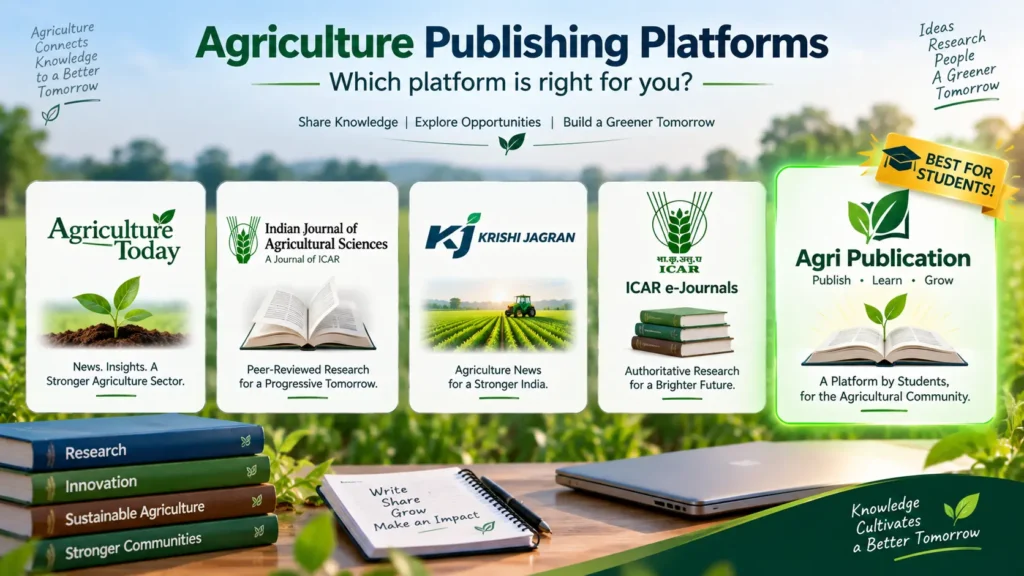
ow that you know the difference between the two formats, the next big question is: Where should you publish? Here are the top 5 platforms in India depending on what you are writing:
1. Agri Publication (Best for Popular Articles & Fast Publication)
What to publish: Popular Articles, Student Assignments, Success Stories, and Short Reviews.
Why choose it: If you are a B.Sc. or M.Sc. student preparing for ICAR JRF or interviews, this is your best option. It provides a highly respected agriculture magazine with ISSN, 24-hour fast-track publication, and an official e-certificate. It is built specifically to make publishing hassle-free for students.
Website: agripublication.com
2. ICAR e-Journals (Best for High-Level Research Papers)
What to publish: Core Research Papers and Data-heavy Studies.
Why choose it: Managed by the Indian Council of Agricultural Research, this portal hosts high NAAS-rated journals. It is perfect for Ph.D. scholars and scientists who have conducted years of field experiments. Note that the review process here is strict and can take several months.
3. Krishi Jagran (Best for Mass Farmer Reach)
What to publish: Popular Articles, Farming News, and Success Stories.
Why choose it: If your goal is to reach actual farmers rather than the academic community, Krishi Jagran is a great magazine. It publishes in multiple regional languages. However, getting published here as a student might take time due to their high volume of journalistic submissions.
4. Indian Journal of Agricultural Sciences (Best for Academic Prestige)
What to publish: Peer-reviewed Research Papers.
Why choose it: This is one of the oldest and most prestigious journals in India. If you have ground-breaking primary data on agronomy or plant pathology, this is the gold standard. It is highly technical and strictly for advanced researchers.
5. Agriculture Today (Best for Agribusiness & Policy)
What to publish: Articles on Agribusiness, Corporate Farming, and Policy Reviews.
Why choose it: This is a premium national agriculture magazine focusing more on the corporate and policy side of agriculture rather than just field science. It is great for MBA (Agri-Business) students.
Top 5 FAQs for the Research Paper vs Popular Article in Agriculture
Yes! Popular articles do not require primary field data. You can write them by studying existing books, reviewing other published literature, and summarizing the information in your own words.
Absolutely. Having published popular articles in a recognized magazine with a valid ISSN demonstrates your communication skills, subject knowledge, and proactive attitude, giving you an edge over other candidates.
A standard popular article in agriculture is usually concise and to the point. It typically ranges from 2 to 4 pages (around 800 to 1500 words), making it a quick and informative read.
You should only use images that are copyright-free, or you must properly credit the original source. Ideally, using your own photographs from college field visits makes your article much more authentic.
For students and scholars seeking fast turnarounds, Agri Publication offers an expedited peer-review process. You can submit your manuscript online and receive a valid ISSN publication and e-certificate within 24 hours.